
 Published on: May 27, 2026
 Category:
Blog Series | Relaxation
Category:
Blog Series | Relaxation
Foundations 101
Our Foundations series consists of practices and protocols we consider fundamental to healthy behavior and happy dogs. Drawn from over 50 years of combined experience in our team and provided to you here, these are the building blocks of the life you imagined with your dog.
Ever wanted to be the Zen master of your dog’s emotions? Or maybe you’re just looking for calm amid the storm, trying to bring Fido and yourself a little peace before bed?
Whatever your situation and goals, from teaching a new puppy to wind down to helping an anxious dog find a calm, safe space, one of the best things you can do for your dog is a Relaxation protocol.
Bonus: It’s really good for you as well, and for your relationship with your best-friend-on-four-legs.
For the Nerds: The Science
Dogs have experienced thousands of years of coevolution with humans, making them the first and only large carnivore to domesticate. Because they exist in such a close symbiotic relationship with mankind (known as mutualism), one of the ways they’ve adapted to life with us is to be very “in tune” with our emotional responses and excellent readers of our facial expressions and body language. Ever felt like your dogs always know how you’re feeling? Likely they do.
The Relaxation protocol leverages our ability to use our own body language and emotional state to help our dogs relax, pairing it with their most important sense organ, the nose.
Studies show that as our dogs and we relax together, our Heart Rate Variances (HRV) synchronize, a sure sign of bonding between two mammals. This connection leads to better communication, a dog that feels more secure in the world, and a healthier behavior profile.
Find the Reason Why
There are many great reasons to practice this protocol with your dog. As we mentioned, it builds relationships and teaches your good boy or good girl to unwind. But what else might it be able to help? We see marked improvement in dogs suffering from phobias, anxiety, Canine Compulsive Disorder (OCD-type/obsessive behaviors in dogs), as well as dogs struggling with hyper-arousal and reactivity. It also shows significant benefits for dogs who are new to the home.
In short, we believe it helps every dog. Some more, some less, and it’s never an answer in and of itself, but it is an instrumental step towards creating the life you imagined with your dog.
What’s your reason for practicing the Relaxation protocol with your best-friend-on-four-legs going to be?
The Instructions – and a Few Very Important Notes
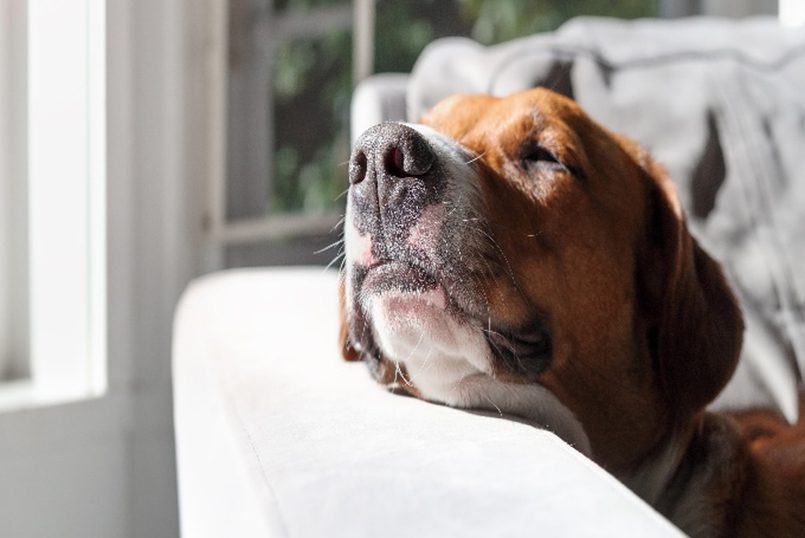
First, don’t be fooled by the nature of this protocol. We’re going to ask you to spray lavender-scented water in the air, and we get why that might seem a little “woo-woo” to some of you. One, it creates a scent-cue that lingers in the air, telling the dog its time to relax. Like a voice saying relax over and over and over again, but this is a lot more effective because the cue “talks” to the dog’s nose. Two, it takes advantage of lavender’s calming effect on dogs, as shown in scientific studies, to make the protocol that much more effective. Still with us? Great! Let’s keep going.
- First, we want to take our dogs for a good play session or, preferably, a long sniffy walk before we practice Relaxation. If we do choose to play, we should play lightly, avoid playing fetch (it’s very arousing for most dogs), and finish with some treat scatters or a lick mat. It’s also helpful to take advantage of naturally sleepy times in your dog’s schedule to practice, so we can watch for the times of day he likes to nap, and practice just beforehand.
- Make sure you’re in a good space to relax as well – both physically and mentally. This won’t work if you’re stuck worrying over something your spouse said or angry at your boss. You’ll need something quiet to do, preferably without electronic light, but if you can’t put the phone away, turn it on silent and turn the screen light down. Reading a book or doing a puzzle is a good example of the kind of activity we recommend.
- We’re going to fill a spray bottle with water and put in 5-10 drops of lavender. We’ll turn the lights down low and put on some relaxing sounds. Nature sounds, or if you like it, reggae or classical music, are ideal choices for your dog’s ability to relax, but remember you have to be able to relax as well, so find a happy medium that works for both of you. Low and slow is the key to the ambiance.
- Once everything is set up, spritz the lavender-scented water several times around the room, and help your dog settle into a favorite bed or blanket with a nice, long-lasting chew. If they resource-guard chews, instead choose a toy or other item they don’t typically guard, and be sure to shut doors or put up gates so you are as uninterrupted as possible during your Relaxation time together.
- You’ll sit down and relax as well. And that’s it. Practice for a half hour to an hour.
Caution
A note about your dog’s nose. It is very sensitive, so we do not recommend using oil diffusers, incense, or air fresheners for this. The lightly scented water is ideal. Additionally, lavender is the ideal scent, but if you don’t care for it, you could try vanilla, coconut, or chamomile. It’s also very important that you choose a brand of essential oil that is pet safe. You could also check into ThunderEssence by ThunderWorks, which we have used.
Some scents are aversive or even toxic for your dog, so avoid clove, citrus, and eucalyptus, and check any scent for pet safety before you use it.
Do You Remember When
You’ve taken your first step on the path to being a doggy Zen Master, and one day soon, you and Fido won’t even remember what life was like before you found your calm time together. But what’s after the first step?
Why, more steps, of course. We’re going to practice together twice a week for at least six weeks before we start using this powerful protocol in other ways. This time is meant to instill in our dog the training necessary to reinforce the scented air as the cue that all is well, and it’s time to relax. After those six weeks, we still need to practice regularly with our dogs, but we can also start turning the lights down, putting on the music, spraying the lavender scented water, and giving fido his chew when we’re leaving for work, or when were having guests over and want him to be calm in another room, or when were training him to be calm at bed time, or in a hotel room when were traveling.
Hopefully, now we begin to see the power of a protocol that creates a lasting cue for “time to relax” and how it facilitates good things for our dog, good things for us, and good things for the life we imagined together.
About the Author
Benjamin Hartwell has studied canine behavior extensively and now practices in the greater Cleveland area and virtually across the nation, and is a co-founder and Executive Director of Bailey’s Fund, a charitable organization dedicated to preserving dog-human families suffering from adverse social determinants of health. He can be reached at insightandinstinctpets.com and Bailey’s Fund — Every Dog Deserves a Second Chance.
Written with special gratitude to Dr. Caitlin Coberly, PhD, CDBC, FFCP-T Dr. Coberly can be found at Caitlin Coberly Academy for Dogs and Humans, Welcome to Kate’s Dogs! – Kate’s Dogs, and insightandinstinctpets.com.
Estimated reading time: 7 minutes
One thought on “Relax…
Don’tDo IT”