
 Published on: June 1, 2026
 Category:
Blog Series
Category:
Blog Series
“I can’t take it anymore. She’s too much for me.”
“Our life revolves around her. It’s not fair to us.”
“I’m not discussing BE. Drop it.”
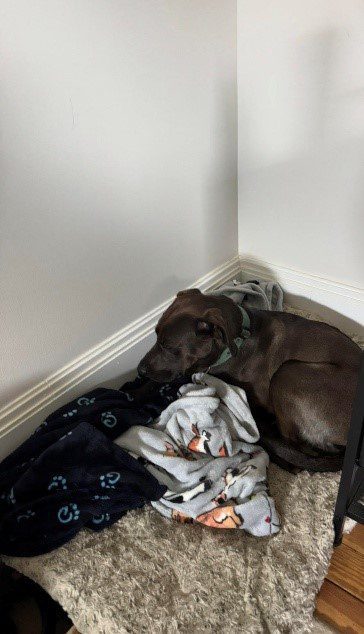
These are all things we’ve said about Bailey, one of our dogs, and easily our most challenging. She’s also our most rewarding dog, in her own way, and has changed our lives for the better in more ways than we can count. The cost of loving a dog with trauma is something we have felt deeply. To say our relationship with her is complex doesn’t do justice to the ups and downs guardians experience with a dog with a history like Bailey’s in their life.
Bailey was taken from her mother and littermates when she was between 4 and 5 weeks old, after which she was kept locked in a kitchen and deprived of exercise and social contact, while also being exposed to domestic violence, heavy drug use and traffic, and aversive training, especially around house training. She suffers from extreme noise phobia, panic disorder, compulsive pacing, extreme confinement anxiety, and mild separation anxiety. When Bailey first came into our care, her panic attacks would last upwards of 12 hours, even with medication. At the time, we learned that a twelve-hour panic attack somehow feels both impossibly long and alarmingly short when you’re living through it.
I want to take a moment here to reassure you that Bailey is doing well. She has a life worth living, and though we have bad days, and will continue to, because progress isn’t linear with dogs like Bailey, she’s happy and has more good days than bad now. There’s a caveat here you need to know about – we are educated professionals, and we enjoy the support of a network of friends who are also professional trainers and behavior consultants from around the world. Loving and helping a dog with a history of trauma isn’t something you do without support, and for good reasons.
You deserve support, compassion, and help, too.
You can read more about how we treated Bailey’s trauma and emotional issues when our website launches, but for now, I want to focus on something else: the costs and the rewards of loving a dog like Bailey.
Anxiety and Learning to Manage Our Own Emotions
Bailey makes us anxious. Often. When she first came to us, it wasn’t uncommon for one of us to escalate with her when she had a panic attack, especially given her intense need for comfort combined with a complete inability to be comforted. She wanted so desperately to feel better, but nothing we did could help in those early days. It takes a lot out of you emotionally, doesn’t it?

And then there’s all the other fears – are you doing enough? Are you making the right decisions for your dog? Are the other pets safe when you leave the house? Are you going to have to say goodbye? Worries about the costs of the vet bills, and if you aren’t fortunate enough to be a professional, the costs of a behavior consultant.
It adds up quickly for the average family, and all that anxiety bleeds over into other areas of your life. Before long, you’ve convinced yourself that every unusual sound in the house is either a behavioral crisis or an expensive veterinary emergency. Sometimes it’s just the ice maker.
But there’s something else that happens here: emotional contagion is a real issue for dogs, and especially for dogs like Bailey. That’s the root of the whole escalating together issue. So, you learn to manage your emotional state, to distance yourself, and take breaks when you need to. You learn that your good boy or girl will be okay without you for a few minutes and will do better in the long run if you take a few moments to calm your nervous system. All that anxiety paradoxically teaches you to be calmer if you get the help and support you need.
You learn to relax with your dog and reverse the spiral. You can read more about this on our website when it launches, too.
Compassion Fatigue, Spoon Theory, and Building a Support System
I can’t say that loving Bailey is hard, but caring for her, especially in the early days, was exhausting at times. To really help a dog like Bailey, you not only have to pour into them when they are in the middle of a panic episode, but you also must treat them outside of those episodes to make any progress. That’s a lot of pouring into one dog when you also have other pets, loved ones, work, and responsibilities. Not to mention yourself to take care of.
It’s enough to emotionally exhaust anyone, and no matter how much you love your dog, it’s okay to be tired of giving to them. It makes sense that supporting a dog through fear and anxiety and panic attacks day in and day out is going to eventually leave you burnt out, especially if it leaves you isolated and you’ve been doing it for weeks, months, or years.

We only have so many spoons to spend a day, as they say, if you’re familiar with Spoon Theory. If you’re not, it’s a metaphor for how we manage our emotional and physical energy each day, with the idea that any given activity requires a certain number of spoons, and we only have so many to spend each day.
A dog like Bailey teaches us to manage our spoons more effectively in life in general, to prioritize what’s important each day, and to give ourselves grace. Bailey, for her part, seems convinced that spoons are magical items that should be left in the most bizarre places she can think of for her human parents. Turns out our good girl isn’t scared of quite everything.
And if we’re very lucky, we realize we need the help I mentioned you deserve earlier, and we start building a support system to meet our needs and our dog’s. We can replenish our spoons with the help of our support system, but we need that system in place to do so.
Isolation, Relationship Stress, and the Deepening Bond
A dog with needs like Bailey’s makes it hard to leave the house as much as you might normally. Even when you do, you find yourself cutting visits short, making apologies. Finding someone you trust to watch a dog with this much trauma, and feeling it’s fair to your dog sitter as well, is no easy task. We had to cut our time at Katie’s brother’s graduation party short for this very reason.

It’s hard. There’s a lot of guilt and shame, and even anger sometimes, attached to the isolation you experience with a dog with a history of severe trauma or other emotional and behavioral issues. Even if you aren’t disappointing other loved ones, you’re often pouring so many spoons into your dog in the early days that you don’t have much left for each other within the household, or for your other pets. Not to mention all the stress in the relationship from high emotions, lack of sleep, arguments, and financial worries. Dogs with severe emotional issues are hard on a relationship and require good communication skills and a commitment to partnership and working through things as a team.
There were times when date nights looked less like a romantic evening and more like two exhausted people sitting on the couch comparing notes about bowel movements, medication schedules, and whether that noise outside was fireworks or the beginning of another rough night.
All those feelings are valid. It costs us to love a dog like Bailey.
On the other hand, though, your bond with your dog and with your loved ones who also care for your dog and live with you grows deeper than you can imagine. Bailey brought Katie and me together, from best friends to a romantic couple, changing my life for the better forever. And that bond has only deepened as we have treated and cared for our girl over time, and as our bond with Bailey has grown.
Bailey has taught me so much about love, recovery, and living an effective life. She is my dog in a way that only she, Katie, and I will ever understand, apart from those of you who have been through the experience of loving a dog with severe trauma and behavioral challenges as they recover with your guidance. You will understand. And if you aren’t there yet, I can’t wait for you to get there.
It’s a life-changing bond, and while I won’t diminish the suffering and adversity you experience, I hope you find it as rewarding as I do.
Besides, one day you may find yourself looking at a dog who once couldn’t cope with the world calmly snoozing beside you and realize that all those difficult days added up to something extraordinary. The dog won’t know how much work it took to get there, of course. They’ll probably just wake up, stretch, and ask for a snack.
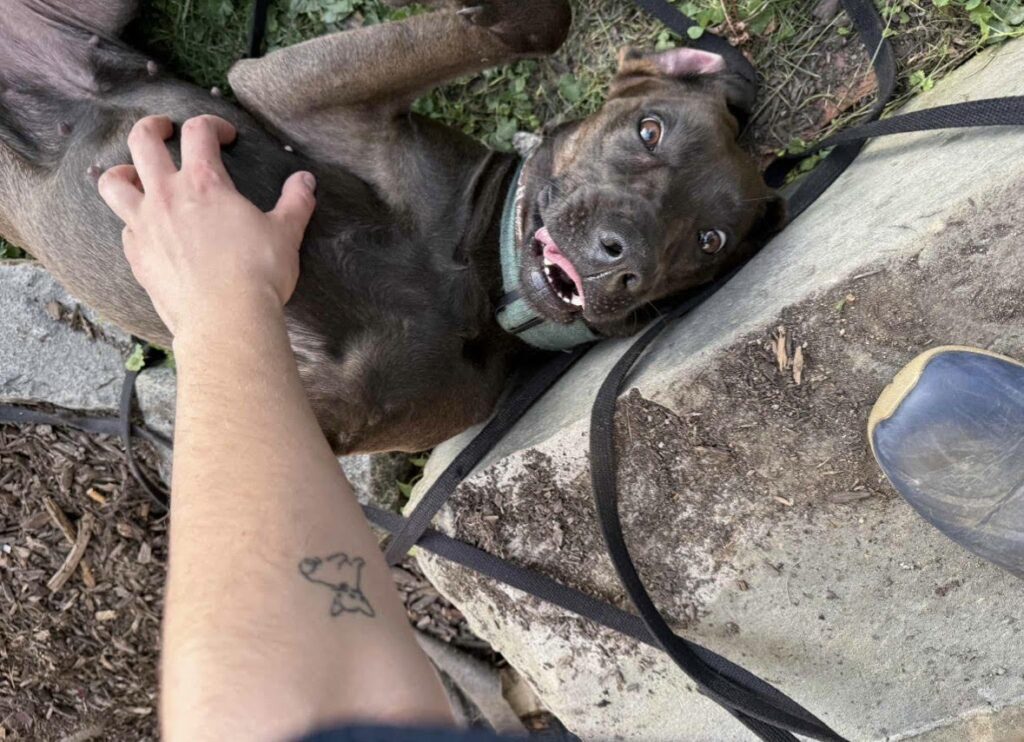
About the Author
Benjamin Hartwell has studied canine behavior extensively and now practices in the greater Cleveland area and virtually across the nation, and is a co-founder and Executive Director of Bailey’s Fund, a charitable organization dedicated to preserving dog-human families suffering from adverse social determinants of health. He can be reached at insightandinstinctpets.com and Bailey’s Fund — Every Dog Deserves a Second Chance.
Estimated reading time: 9 minutes
Table of contents
- “I can’t take it anymore. She’s too much for me.”
- “Our life revolves around her. It’s not fair to us.”
- “I’m not discussing BE. Drop it.”
- Anxiety and Learning to Manage Our Own Emotions
- Compassion Fatigue, Spoon Theory, and Building a Support System
- Isolation, Relationship Stress, and the Deepening Bond
- About the Author
One thought on “The Emotional Cost – and Reward – of Loving a Dog with a History of Trauma”